Kaggle has firmly established itself as a dominant platform in the world of data science, providing tools, resources, and a community for people passionate about data, machine learning, and artificial intelligence.
Launched in 2010 and acquired by Google in 2017, Kaggle has evolved from a platform centered around competitions to a comprehensive ecosystem for learning, collaborating, and experimenting with data science.
With millions of users worldwide, Kaggle has become a go-to destination for individuals who want to learn data science, showcase their skills, and collaborate with other like-minded professionals.
What sets Kaggle apart from other platforms is its accessibility and range of resources. Whether you’re a student just starting your journey in data science or an experienced professional looking to hone your skills, Kaggle provides free access to a wealth of datasets, coding environments, and educational courses.
Beyond the datasets and coding environments, Kaggle is also home to some of the world’s most challenging data science competitions, where participants can test their skills against the best minds in the field.
For many, Kaggle serves as a hands-on learning environment, where theory meets practice. It allows users to interact with real-world problems, learn from community-driven discussions, and collaborate on projects that make a tangible impact. In this review, we will explore the features, benefits, challenges, and overall value Kaggle offers to those in the data science field.
What is Kaggle?
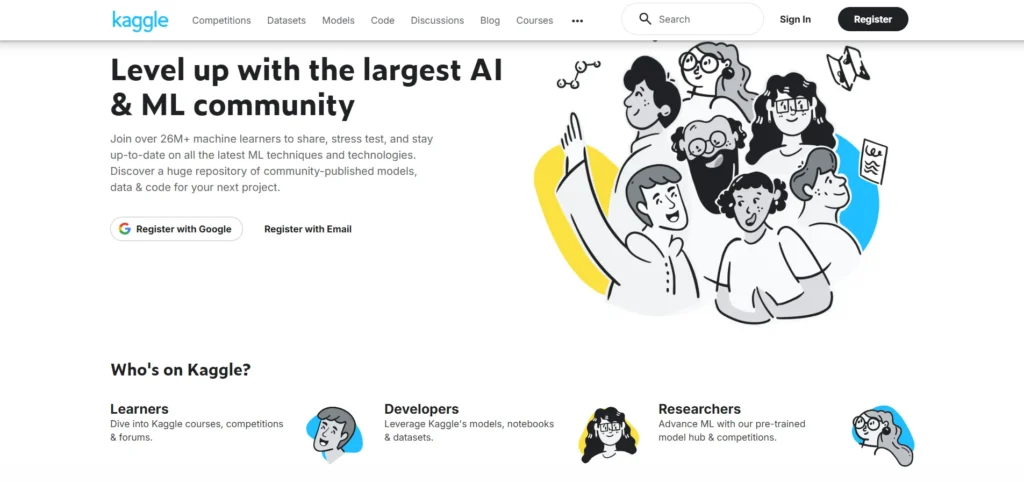
Kaggle started as a platform for data science competitions, where organizations could post challenges and offer prizes to those who created the best solutions. Over the years, it has evolved significantly and is now a multifaceted platform that provides resources for learning, developing machine learning models, exploring datasets, and sharing solutions.
Today, Kaggle is recognized as the world’s largest data science and machine learning community, with millions of active users, including data scientists, machine learning engineers, statisticians, and students. The platform’s appeal lies in its accessibility, its vast dataset repository, and its emphasis on practical, hands-on learning.
The Community Aspect of Kaggle
What truly sets Kaggle apart from other platforms is its vibrant, supportive community. Whether you’re working on your first competition or collaborating on a machine learning project, you’ll find countless opportunities to learn from others. Kaggle’s forums, where users share their experiences, discuss challenges, and offer guidance, are a big part of the platform’s success. It’s this community-driven approach that makes Kaggle not only a place to learn but also a place to grow your skills through interaction with like-minded individuals.
Key Features of Kaggle
1. Massive Repository of Datasets
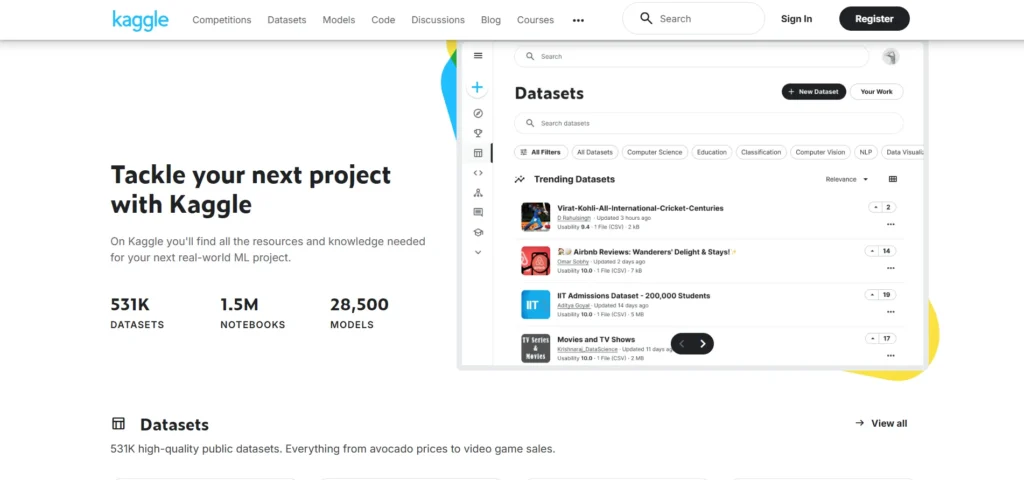
One of the most appealing features of Kaggle is its vast collection of datasets. As of 2023, Kaggle hosts over 513,000 datasets across various domains, including healthcare, finance, entertainment, sports, and more. Whether you’re interested in structured datasets (such as CSV files) or unstructured data (like images and text), you’ll find something to suit your needs.
For data scientists, having access to high-quality, diverse datasets is essential for building machine learning models and conducting analyses. Kaggle ensures that datasets are easy to access and often come with descriptions, example notebooks, and pre-built scripts to get you started. This is perfect for both beginners and experts, as it allows users to skip the data wrangling phase and focus on the analysis and modeling.
2. Jupyter Notebooks for Data Exploration
Kaggle provides an integrated, browser-based environment where users can write and run code. This environment is based on Jupyter Notebooks, which allows for interactive data analysis, modeling, and visualization. These notebooks can be run directly on Kaggle’s platform, so you don’t need to worry about setting up a local environment.
Users also have access to free computational resources, including GPU and TPU support, making Kaggle a great place to run deep learning models without having to invest in expensive hardware. Kaggle’s free notebook environment reduces the barriers to entry for those who may not have access to powerful machines.
3. Data Science Competitions
Competitions are at the heart of Kaggle’s ecosystem. The platform hosts a variety of challenges, ranging from beginner-friendly projects to complex, real-world problems sponsored by major companies. Kaggle competitions offer monetary rewards, job opportunities, and prestige, making them highly competitive.
In these competitions, participants are provided with datasets and tasked with creating predictive models or solving specific problems. Solutions are ranked based on performance metrics such as accuracy, AUC score, or log loss. Many top data scientists use Kaggle competitions to showcase their skills and earn recognition from the global data science community.
Competitions are also a great way to practice and improve your skills. For beginners, Kaggle provides tutorials and starter notebooks that break down the process of participating in a competition step by step. For more advanced users, the opportunity to compete against some of the best minds in data science is invaluable.
4. Kaggle Courses
Kaggle offers free, self-paced courses on a wide range of data science topics. These courses are designed to be hands-on and interactive, with real-world examples and exercises that help users apply what they learn. The courses cover everything from basic Python programming to advanced machine learning concepts.
Kaggle’s courses are organized into bite-sized modules, making it easy to learn at your own pace. Whether you’re looking to learn the basics of Python or want to dive into more complex topics like deep learning or natural language processing, Kaggle’s courses offer a structured way to learn.
5. Kernels (Code Notebooks)
Kaggle’s code notebooks, known as kernels, allow users to share and collaborate on their data science projects. These notebooks contain both code and narrative, so other users can easily follow the logic and methodology behind a project. Kernels are publicly accessible, so users can explore how others approach problems and learn new techniques.
Kernels are also a great way to collaborate with others. You can fork a kernel, make changes, and improve upon the original idea. This makes Kaggle a great platform for peer-to-peer learning and collaboration.
Courses Offered on Kaggle
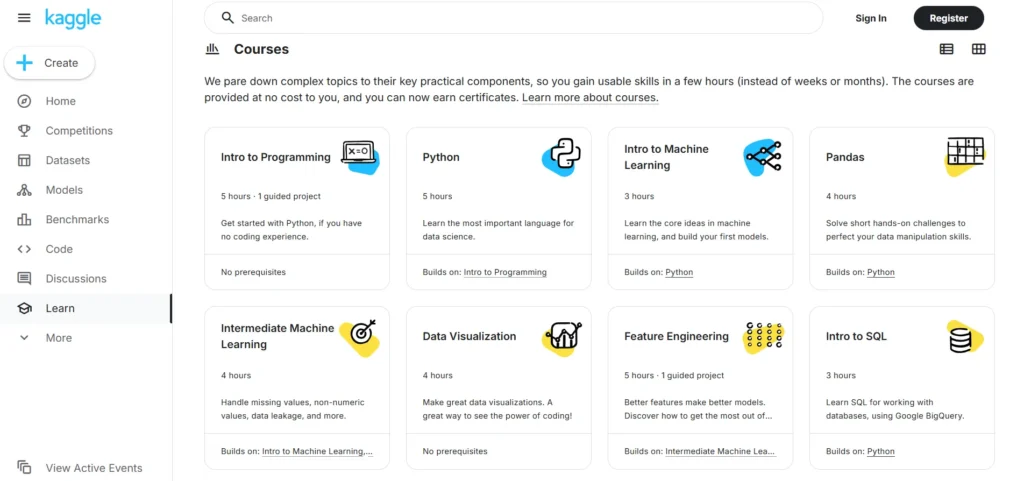
Kaggle Learn is the educational arm of Kaggle, offering free, short, and practical courses in data science and machine learning. These courses are designed for beginners and intermediate learners, focusing on practical skills rather than theoretical knowledge.
Some of the popular courses include:
- Python: This beginner-friendly course teaches the basics of Python programming, including data structures, loops, and functions.
- Machine Learning: Kaggle offers an introductory course on machine learning, covering topics such as supervised and unsupervised learning, classification, regression, and model evaluation.
- Data Visualization: This course covers the basics of creating visualizations using Python libraries like Matplotlib and Seaborn.
- Deep Learning: A more advanced course that introduces neural networks, convolutional networks, and how to build deep learning models.
- Natural Language Processing (NLP): Focuses on working with text data, including sentiment analysis and text classification.
Each course includes interactive coding exercises, quizzes, and practical examples that allow you to apply the skills you’re learning immediately. The courses are designed to be completed at your own pace and typically take anywhere from 3 to 7 hours to finish.
Pricing of Kaggle
One of the most attractive aspects of Kaggle is its pricing: everything is free. Whether you’re using the datasets, running models in the notebooks, participating in competitions, or taking courses, there are no hidden fees. This makes Kaggle an accessible platform for anyone interested in data science, regardless of their financial situation.
For students and professionals alike, free access to high-quality resources is a game-changer. While other platforms may charge for premium features or access to certain datasets, Kaggle remains committed to providing all of its tools and resources at no cost.
Pros and Cons of Kaggle
Pros
- Free Access: All features, including datasets, competitions, courses, and computational resources, are completely free.
- Vast Dataset Collection: With over 500,000 datasets, Kaggle offers an extensive repository that can be used for a wide variety of projects.
- Active Community: Kaggle’s community is large, diverse, and extremely helpful. Users can share knowledge, collaborate on projects, and learn from each other.
- High-Quality Learning Materials: The courses on Kaggle are well-structured, practical, and hands-on, providing real-world examples to reinforce learning.
- Competitions for Career Advancement: High-ranking participants in Kaggle competitions can gain recognition from top companies and improve their chances of landing a data science job.
Cons
- Steep Learning Curve for Beginners: While Kaggle is user-friendly, the sheer volume of resources and the complexity of some competitions can be overwhelming for newcomers.
- Lack of Personalized Support: Kaggle offers community support but does not provide one-on-one assistance or personalized mentoring, which might be a drawback for some learners.
- High Competition Intensity: The competition can be fierce, especially in advanced competitions, where only the best solutions make it to the top.
- Limited Advanced Courses: While Kaggle offers an excellent range of beginner and intermediate courses, more advanced topics are somewhat limited.
- Platform Overload: Due to its popularity, Kaggle has a vast number of participants and projects, which can sometimes make it difficult to stand out or receive recognition.
Conclusion
Kaggle is a powerhouse in the world of data science. With its wealth of resources, free access to powerful computational tools, and a thriving community of users, it’s the go-to platform for anyone looking to learn, practice, or compete in data science. Whether you’re a beginner wanting to learn Python or a professional aiming to enhance your deep learning skills, Kaggle has something for you.
The platform’s unique blend of practical learning, hands-on experience, and community engagement makes it one of the most valuable resources for data scientists. Its competitions, courses, and datasets offer unparalleled opportunities for growth and career advancement.
While there are some challenges, such as the steep learning curve for beginners and the intense competition in certain challenges, the benefits far outweigh the drawbacks. If you’re serious about data science, Kaggle is a platform that you can’t afford to overlook.
FAQs
Is Kaggle free to use?
Yes, all features on Kaggle, including datasets, courses, and competitions, are free.
Do I need programming experience to use Kaggle?
Basic programming knowledge, particularly in Python, is beneficial but not mandatory. Kaggle offers courses to help beginners get started.
Can I use Kaggle for commercial purposes?
Yes, you can use Kaggle’s datasets and models for commercial purposes, but make sure to check the licensing terms.
How do I participate in Kaggle competitions?
Simply create an account on Kaggle, browse active competitions, and submit your solutions as per the competition guidelines.
Are Kaggle’s courses suitable for beginners?
Yes, Kaggle’s courses are designed to be beginner-friendly and provide hands-on, practical learning.