Best online linux foundation courses number in the dozens, so after working through a healthy stack of them I can save you the trial and error and point you at the ones that earn their spot.
I care about hands-on labs, honest pricing, and a clear line from the classroom to a real job, not marketing gloss.
Whether you want your first Linux certification, a Kubernetes training path, or a DevOps skill jump, this roundup sorts the catalog into picks you can act on today.
One honest note to you as the reader: the bracketed spots below are where my own hands-on impressions go, so read those as mine to fill in.
How I Ranked These Courses?
I did not rank by name recognition. I ranked by what actually moves a career forward, and I weighed each course against the same yardstick.
- Hands-on labs over lecture. Courses with in-browser labs or real terminal practice scored higher than reading-only modules, since the command line rewards reps.
- Price and payoff. I looked at cost next to the salary and roles each skill opens, then favored strong return per dollar.
- Path to a credential. Bonus points when a course feeds a respected exam like the CKA, CKAD, CKS, or LFCS.
- Freshness. Recently updated classes beat stale ones, because cloud-native tools move fast and old screenshots age badly.
- Beginner friendliness. I checked whether a newcomer could follow along without getting lost in jargon.
That scoring shaped every pick below, and it is why some famous names sit lower than you might expect.
Quick-Look Comparison of the Top Linux Foundation Online Courses
Skimmers, this table is for you. Here are the standout online classes at a glance, with 2026 pricing from the official Linux Foundation catalog.
| Course | Code | Level | Price (USD) | Best for |
| Introduction to Linux | LFS101 | Beginner | Free | First-time Linux users |
| Introduction to Kubernetes | LFS158 | Beginner | Free | Container newcomers |
| Kubernetes Fundamentals | LFS258 | Intermediate | Paid, self-paced | Future CKA holders |
| Kubernetes for Developers | LFD259 | Intermediate | $299 | Future CKAD holders |
| Kubernetes Security Essentials | LFS260 | Advanced | Paid | Future CKS holders |
| Linux System Administration Essentials | LFS207 | Intermediate | Paid | Future LFCS holders |
| DevOps and SRE Fundamentals | LFS261 | Intermediate | Paid | CI/CD and SRE roles |
| Secure Software Development | LFD121 | Beginner | Free | Developers new to security |
Best Linux Foundation Courses for Beginners
Everyone has to start somewhere, and these two free classes are where I send friends who are brand new to open source.
Introduction to Linux (LFS101)
If you have never touched a terminal, this is the on-ramp. Introduction to Linux (LFS101) is free, self-paced, and one of the most popular beginner programs in the whole field.
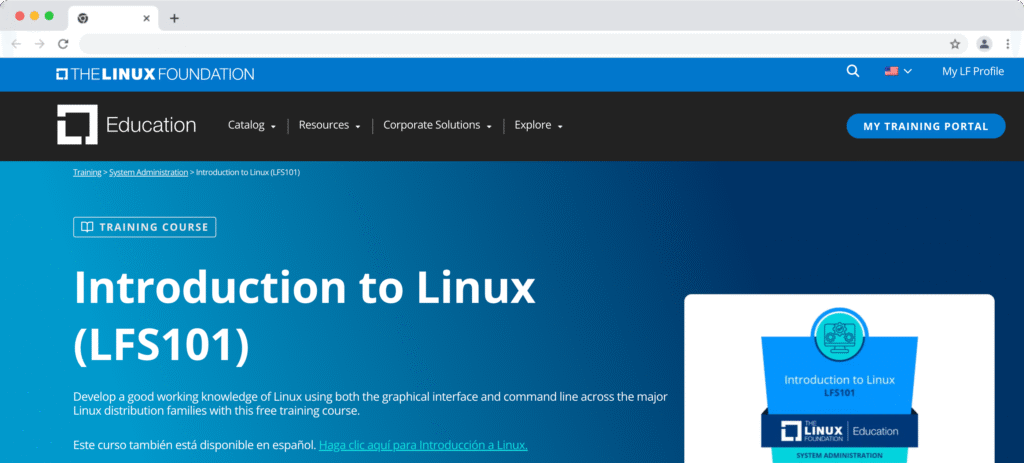
It walks you through the graphical desktop, the file system, and the basics of the command line, so you build a working mental map of how Linux thinks.
My honest read matches the wider community sentiment: the content leans more toward theory than practice. You will finish able to describe how Linux works, yet you still need to open your own terminal to make the skills stick.
For a zero-cost start with no risk, it is still the first course I recommend, as long as you pair it with your own hands-on tinkering from day one.
Best Free Kubernetes Primer: Introduction to Kubernetes (LFS158)
Once Linux feels less scary, Introduction to Kubernetes (LFS158) is the natural next free step.
This primer breaks down container orchestration in plain language, covering pods, deployments, and how a cluster keeps your apps running when things go sideways.
What I like most is the framing. LFS158 gives you the vocabulary and the big-picture model before you spend a cent on paid Kubernetes training, so you walk into a deeper course already knowing the map.
Treat it as your free scouting trip. It will not certify you, but it makes every paid class that follows land faster and cost you less confusion.
Best Linux Foundation Courses for Cloud and Kubernetes
This is the money lane for many careers, and the Linux Foundation stewards the very projects these courses teach. Here are my top cloud-native picks.
Best Paid Admin Track: Kubernetes Fundamentals (LFS258)
Kubernetes Fundamentals (LFS258) is my pick for anyone chasing the Certified Kubernetes Administrator badge.
The Linux Foundation relaunched this course in early 2026 with fully hosted, in-browser labs that need zero local setup, which fixed the biggest old complaint about fiddly environments.
You learn to deploy a containerized app, manage a multi-node cluster, and keep production workloads healthy.
The hosted labs are the reason it ranks so high for me. Reading about Kubernetes teaches you nothing your fingers remember, so practicing inside a real cluster in the browser is the whole game.
Best Developer Track: Kubernetes for Developers (LFD259)
If you write code rather than run clusters, Kubernetes for Developers (LFD259) is your track, and it feeds the Certified Kubernetes Application Developer exam.
Priced at $299 for the course alone, it teaches you to containerize, host, deploy, and configure an application across a multi-node cluster, starting from a simple Python script and building up to a production-ready setup.
It is not a total beginner course, so come prepared. The Linux Foundation lists a few prerequisites worth respecting:
- Comfort with the Linux command line.
- Working knowledge of a language like Python, Node.js, or Go.
- A basic grasp of cloud-native application concepts and architecture.
Meet those, and LFD259 gives developers a direct route to the CKAD. Skip them, and you will spend the course playing catch-up instead of learning the good stuff.
Best Security Track: Kubernetes Security Essentials (LFS260)
For the security-minded, Kubernetes Security Essentials (LFS260) is the class that preps you for the Certified Kubernetes Security Specialist exam.
It digs into hardening clusters, locking down workloads, and defending the supply chain around your containers.
One gate matters here. The CKS exam requires a current CKA first, so this course sits at the top of the Kubernetes ladder, not the bottom.
I would only reach for LFS260 once cluster administration already feels natural, since security concepts land better when you understand what you are protecting.
For DevSecOps and platform engineers, though, this is the credential that makes a resume stand out in a crowded field.
Best for System Administrators and DevOps
Not everyone lives in Kubernetes. These picks serve the sysadmin and delivery crowd who keep the lights on.
Best SysAdmin Path: Linux System Administration Essentials (LFS207)
Linux System Administration Essentials (LFS207) is my choice for anyone aiming at the Linux Foundation Certified System Administrator credential.
It builds the background you need to work as a Linux sysadmin, covering user management, networking, storage, and the daily command-line tasks that fill a real job.
The LFCS it feeds carries a three-year validity, longer than the two-year Kubernetes certs, so the payoff sticks around.
For career changers moving into operations, this course plus the LFCS is a clean, respected first credential that proves you can run a system rather than just talk about one.
Best DevOps Pick: DevOps and SRE Fundamentals (LFS261)
DevOps and SRE Fundamentals: Implementing Continuous Delivery (LFS261) targets the pipeline crowd.
It teaches you to ship software with confidence using continuous integration and continuous delivery processes and tools, which is the heartbeat of modern release work.
I like this one for engineers who already know Linux and now want to automate deployments. It suits aspiring site reliability engineers and DevOps practitioners who need to turn manual, nerve-wracking releases into calm, repeatable ones.
The course stays practical, and the CI/CD skills transfer to almost any stack you land on next.
Best Free Security Course: Secure Software Development (LFD121)
Rounding out the free tier, Secure Software Development (LFD121) teaches developers the security basics that harden software against attacks.
It covers how vulnerabilities creep in and how to shrink the damage when something slips through.
At zero cost with a certificate of completion, LFD121 is an easy yes for any coder who never got formal security training.
It will not make you a penetration tester, but it plants the right habits early, and secure coding is a skill every team wishes more developers had.
Best Value Overall: The THRIVE-ONE Subscription
If you plan to study more than one topic, the THRIVE-ONE annual subscription is the smartest money on the menu.
It bundles unlimited access to more than 100 educational products, including paid courses like Kubernetes for Developers, along with SkillCred exams, premium microlearning, and digital badges.
The standard plan also folds in one certification exam voucher for the CKA, CKAD, CKS, or LFCS.
Here is the math that sold me. A single exam runs $445, and stacking the exam with THRIVE-ONE lands around $625, which costs less than buying the exam and the subscription apart.
So if you want a credential plus a year of self-paced e-learning, the bundle turns a pile of separate purchases into one fair price.
For a career changer soaking up several skills at once, it is the closest thing to an all-you-can-learn pass the Linux Foundation offers.
Free Versus Paid: Which Linux Foundation Courses Are Worth Money
People always ask whether the paid classes justify the spend, so here is my rule.
Go free when you are testing the waters, learning fundamentals, or filling knowledge gaps. LFS101, LFS158, and LFD121 give real teaching at zero risk, and there is no shame in starting there. They are perfect for exploring whether a Linux or cloud-native career even fits you.
Pay when you want a credential and hands-on labs that mirror the real exam. The paid tracks like LFS258, LFD259, LFS260, and LFS207 exist to carry you across the finish line of a proctored test, and that is where they earn their price.
Buying a paid course without a certification goal is where money gets wasted, since the free tier already covers the theory. Match the spend to a clear outcome and you will rarely regret it.
How to Choose the Right Linux Foundation Course for Your Goal?
Still stuck? Follow this short decision path and let your target job pick the course for you.
- Total beginner? Start with LFS101, then LFS158. Spend nothing until you know the field suits you.
- Want to run clusters? Take LFS258 and aim at the CKA.
- Write code for Kubernetes? Take LFD259 and aim at the CKAD.
- Focused on security? Earn the CKA first, then take LFS260 toward the CKS.
- Heading into operations? Take LFS207 and aim at the LFCS.
- Building pipelines? Take LFS261 for CI/CD and SRE skills.
- Studying several topics this year? Buy THRIVE-ONE and stop counting individual course fees.
My Verdict: Where to Start Today?
After running the whole catalog through the same test, my shortlist is simple. Begin free with LFS101 and LFS158 to build a base at no cost.
When you are ready to commit, LFS258 toward the CKA is the strongest paid pick for cloud-native careers, with LFD259 for developers and LFS207 for sysadmins close behind.
If you plan to study widely this year, THRIVE-ONE turns a scattered set of purchases into one fair fee. Pick the course that matches the door you want to open, put in the reps, and the Linux Foundation catalog will carry you further than you expect.
FAQs
Are Any Linux Foundation Courses Free?
Yes. Several beginner classes, including Introduction to Linux (LFS101), Introduction to Kubernetes (LFS158), and Secure Software Development (LFD121), cost nothing and still teach real material.
Do I Need The Linux Foundation Course To Pass The Certification?
No. Exams sell separately, and experienced engineers often buy the exam alone. The paid courses help most when you want structured prep and hands-on labs that mirror the test.
Can I Get A Refund From Linux Foundation If A Course Does Not Fit?
Self-paced e-learning is refundable within 14 days if you have completed less than a quarter of it, and first-time THRIVE-ONE subscriptions carry a 14-day refund window. Always check the current terms before buying, since policies shift.
How Do I Save Money On Linux Foundation Courses?
Watch for seasonal sales and the Tux Rewards points program, which regularly cut 40 to 50 percent off exams and bundles. Rarely pay full sticker if you can wait a few weeks.