The best Kubernetes courses on the Linux Foundation are not scattered random picks, they are a tight ladder where each course points straight at a certification employers respect.
I worked through the tracks and sat the exams, and the thing that tripped me up early was not the material; it was figuring out which course feeds which badge.
A quick note on method: I judged each course on hands-on labs, how current the content is, price honesty, and how well it preps the matching exam. The bracketed spots are where my own hours and impressions go.
How the Linux Foundation Kubernetes Courses Fit Together?
Before the picks, see the shape of the ladder. The Linux Foundation builds its Kubernetes training as a set of self-paced courses, and each one lines up with a specific certification.
Once you see the map, the buying choice gets simple.
- Start point: LFS250 and the LFS158 primer teach cloud native basics and prep the entry-level KCNA.
- Administrator track: Kubernetes Fundamentals (LFS258) builds cluster operation skills and preps the CKA.
- Developer track: Kubernetes for Developers (LFD259) teaches app building on Kubernetes and preps the CKAD.
- Security track: Kubernetes Security Essentials (LFS260) hardens clusters and preps the CKS, which needs a CKA first.
- Support courses: containers, service mesh, and GitOps classes round out real production skills.
Every self-paced course sits at a $299 list price on its own, and each matching exam runs $445. Keep that pairing in mind as you read, because it drives every recommendation below.
Quick Comparison of the Best Linux Foundation Kubernetes Courses
Here is the whole core lineup on one screen. Prices reflect 2026 list rates and drop during the frequent sales.
| Course | Code | Level | Length | Course price | Preps for |
| Kubernetes and Cloud Native Essentials | LFS250 | Beginner | Self-paced | $299 | KCNA |
| Introduction to Kubernetes | LFS158 | Beginner | Self-paced | Free primer | KCNA basics |
| Kubernetes Fundamentals | LFS258 | Intermediate | About 35 hours | $299 | CKA |
| Kubernetes for Developers | LFD259 | Intermediate | Self-paced | $299 | CKAD |
| Kubernetes Security Essentials | LFS260 | Advanced | Self-paced | $299 | CKS |
Best Kubernetes Course for Beginners: LFS250 and LFS158
New to containers and clusters? Do not jump straight at the CKA. These two beginner courses build the base that makes everything after them click.
Kubernetes and Cloud Native Essentials, LFS250
This is where I send true beginners first. LFS250 gives you a broad look at cloud native technology and how container orchestration works, without assuming you already speak Kubernetes.
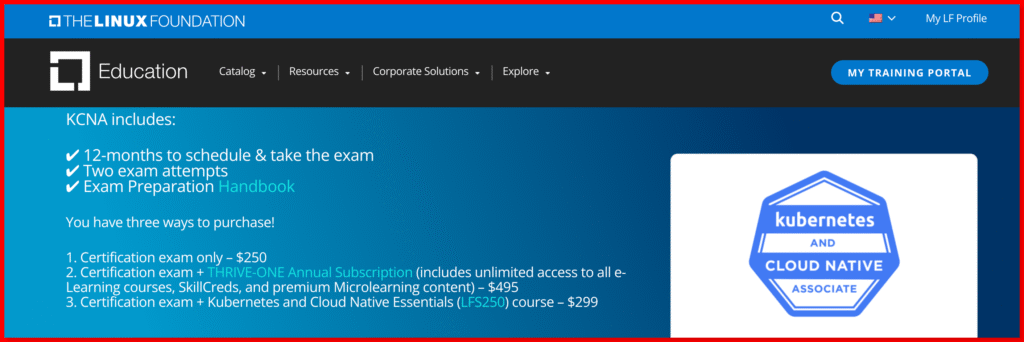
It preps you for the Kubernetes and Cloud Native Associate (KCNA) exam, an entry-level, multiple-choice test that costs $250 and makes a friendly first credential for career changers.
What I liked:
- Beginner pacing that never drowns you in cluster internals.
- A clear on-ramp to the KCNA, so your study has a finish line.
- Broad cloud native context that helps later courses make sense.
The trade-off is depth. LFS250 gives you the map, not the muscle, so treat it as orientation before the heavier tracks.
Introduction to Kubernetes, LFS158
Want to test the water for free? LFS158 is a primer on Kubernetes as a system for managing containerized apps in a cluster.
It costs nothing to start, which makes it a smart way to confirm this whole field is for you before spending a cent. It will not hand you a heavyweight credential, so pair it with LFS250 when you are ready for structure and a badge.
What I liked:
- Free entry with no commitment.
- A gentle first look at pods, clusters, and orchestration.
- A natural lead-in to the paid essentials course.
Best Course for Administrators: Kubernetes Fundamentals, LFS258
If your goal is the Certified Kubernetes Administrator badge, this is the course that gets you there, and it just got a lot better.
The Linux Foundation relaunched Kubernetes Fundamentals (LFS258) in February 2026 as an updated, self-paced course with fully hosted, in-browser labs, so you spend your time working directly with Kubernetes instead of fighting a local setup.
It runs about 35 hours of material and builds the skills to install, configure, and operate production clusters.
The course walks you through installing and configuring clusters, deploying and managing apps with core primitives, exposing services with Services, Ingress, and the Gateway API, and applying security, logging, troubleshooting, and high availability practices.
That scope lines up closely with what the CKA exam tests, and the CKA sits at $445 on its own.
What I liked:
- The February 2026 refresh with in-browser labs, so no local install headaches.
- Hands-on, lab-driven learning that mirrors real cluster work.
- Tight alignment with the CKA blueprint, from install to troubleshooting.
- A low $299 course price, or a bundle path if you want the exam too.
One honest caveat: a course alone rarely carries you across the CKA finish line. Pair LFS258 with real practice and the included exam simulator, and you give yourself a fair shot.
Best Course for Developers: Kubernetes for Developers, LFD259
Are you a developer who needs to ship apps on Kubernetes, not run the cluster itself? Kubernetes for Developers (LFD259) is built for you.
Starting from a simple Python script, the course teaches you to containerize, host, deploy, and configure an app in a multi-node cluster, then monitor and troubleshoot it like you would in production.
The chapters march through Kubernetes architecture, build, design, deployment configuration, security, exposing applications, and application troubleshooting.
That path maps directly onto the Certified Kubernetes Application Developer (CKAD) exam, which runs $445 on its own.
The course expects you to be comfortable with the Linux command line and a language like Python, Node.js, or Go, so it is not an absolute-beginner class.
What I liked:
- A developer lens that skips cluster-admin detail you do not need.
- A real app-building arc, from script to deployed, scalable service.
- Clean alignment with the CKAD, so your study time counts twice.
If you have never touched a terminal or written code, start with the beginner courses first, since LFD259 assumes those basics.
For the in-depth insights i have covered it all inside my Linux Foundation review, from pricing to is it worth it.
Best Course for Security: Kubernetes Security Essentials, LFS260
Kubernetes Security Essentials (LFS260) covers best practices for securing container-based apps and Kubernetes platforms across build, deployment, and runtime.
It preps the Certified Kubernetes Security Specialist (CKS) exam, which also costs $445.
One rule matters here: the CKS has a prerequisite. You must hold an active, non-expired CKA before you can schedule the CKS, so this course belongs later in your journey, not at the start. The chapters cover cloud security overview, preparing to install, installing the cluster, securing the kube-apiserver, networking, workload considerations, and issue detection, with hands-on labs to build and secure a real cluster.
What I liked:
- A runtime-to-supply-chain view of Kubernetes security, not just theory.
- Hands-on labs that build and defend an actual cluster.
- Direct prep for the CKS, the credential that sets security pros apart.
The catch is the prerequisite chain. Budget for the CKA first, then layer the CKS on top once you hold it.
Supporting Cloud Native Courses on Linux Foundation
The core four cover the certifications, but a few extra Linux Foundation Kubernetes training courses round out the production skills employers actually want. Add these once your base is solid.
- Containers Fundamentals (LFS253): the container basics under everything Kubernetes does, a smart prerequisite mindset builder.
- Introduction to Istio (LFS144): service mesh skills for connecting, securing, and monitoring microservices.
- Introduction to Cilium (LFS146): a practical intro to Cilium as a Kubernetes networking plug-in, with observability through Hubble.
- Continuous Delivery on Kubernetes with Flux (LFS269): modern deployment workflows that many DevOps roles now expect.
None of these carries a Kubernetes certification on its own, so treat them as skill boosters that make you more useful on the job rather than badge chasers.
Course, Subscription, or Exam Bundle: Which Buying Path Wins?
The Linux Foundation sells its Kubernetes courses three ways, and picking the right one saves real money. Here is how I would choose.
Course only, $299. Best when you already plan to buy the exam separately, or when you want the learning now and the credential later. It is the cheapest entry to the material.
Course plus THRIVE-ONE annual subscription, $625. THRIVE-ONE unlocks unlimited access to more than 100 e-learning products, SkillCreds, and premium microlearning for a flat yearly fee.
This path wins if you plan to study several courses in one year, since one subscription covers the whole catalog.
Exam plus course bundle, around $645. This pairs the matching course with the certification exam in a single purchase, which saves money against buying both apart.
Pick it when you are committed to sitting the exam and want the prep bundled in.
My rule of thumb: buy the exam-plus-course bundle if you are certain about the certification, choose THRIVE-ONE if you want the whole library for a year, and grab the $299 course alone if you just want to learn without committing to an exam date yet.
The Kubestronaut Path: All Five Kubernetes Certifications
Want to go all the way? The Linux Foundation groups its five Kubernetes credentials into a full path, and finishing all five earns you Kubestronaut status.
Here is the ladder with 2026 list prices and the course that preps each rung.
| Certification | Price (USD) | Level | Preps with |
| KCNA (Cloud Native Associate) | $250 | Entry | LFS250 |
| KCSA (Security Associate) | $250 | Entry, security | LFS250 plus security study |
| CKA (Administrator) | $445 | Professional | LFS258 |
| CKAD (Application Developer) | $445 | Professional | LFD259 |
| CKS (Security Specialist) | $445 | Advanced | LFS260 |
Buying the five-exam bundle saves against separate purchases, up to a few hundred dollars depending on the current promotion.
If you are building a serious cloud-native career, the full path is the strongest signal you can send, and the renewal rules reward people who climb rather than stop at one badge.
How Do These Courses Prep You for the Exams?
A course teaches, but the exam is its own beast, so know what waits. The CKA, CKAD, and CKS are online, proctored, performance-based tests.
You solve real tasks from a command line running Kubernetes, with two hours on the clock and a 66% score needed to pass the CKA.
The CKA currently runs on Kubernetes v1.35, and the exam version updates within about four to eight weeks of each new Kubernetes release, so always confirm the version before you finalize your prep.
Here is the part I lean on hardest: each professional exam includes access to the Killer.sh simulator, with two attempts and a long access window on each.
The simulator drops you into a near-identical environment and exposes your weak spots fast. Running it early, not the night before, did more for my confidence than any lecture.
Pair the matching course with the simulator and daily terminal reps, and you walk in ready instead of hopeful.
How to Choose Your Linux Foundation Kubernetes Course?
Still weighing options? Run this quick decision path and the right course usually falls out.
- Name your role. Administrator points to LFS258, developer to LFD259, security to LFS260, and total beginner to LFS250.
- Check the prerequisites. The CKS needs an active CKA first, so plan the order rather than buying out of sequence.
- Grade your base. If Kubernetes is brand new, start with the free LFS158 primer before paying for anything.
- Pick a buying path. One exam means the course-plus-exam bundle, several courses in a year means THRIVE-ONE, and learning-only means the $299 course.
- Confirm the exam version. Check the current Kubernetes version on the exam page so your study materials match.
Follow those five steps and you skip the classic mistake of buying the wrong course for your actual goal.
My Top Pick by Role
If you want one clean recommendation, here it is by reader type. Total beginners should start with the free LFS158 primer, then LFS250 toward the KCNA.
Future administrators should take Kubernetes Fundamentals (LFS258) and aim at the CKA, since its February 2026 relaunch with in-browser labs makes it the strongest starting course in the lineup.
Developers get the most from Kubernetes for Developers (LFD259) and the CKAD, and security-minded pros should hold their CKA first, then take Kubernetes Security Essentials (LFS260) for the CKS.
Whichever path you pick, pair the course with the exam simulator, practice in a real cluster every day, and the badge will follow faster than you expect.
FAQs
Do The Linux Foundation Courses Or Certifications Expire?
The self-paced courses stay available to you, but the professional certifications carry a validity window and need renewal by retaking the exam, so mark your expiry date early.
What Is The Best Linux Foundation Kubernetes Course For Beginners?
For complete beginners, Introduction to Kubernetes (LFS158) is a strong starting point because it is free and covers Kubernetes architecture, core components, clusters, and basic application deployment.
Is Kubernetes Fundamentals (Lfs258) Good For New Students?
LFS258 is more practical and is aimed at building skills for production-facing Kubernetes roles. It requires working knowledge of Linux, so a complete beginner may want to start with LFS158 or LFS250 first.